
 USD ($)
 EUR (€)
 JPY (¥)
 SGD (S$)
SKU
01121002
2021 1/2 oz Austria Gold 2021 1/2oz Austria Gold The treasure of the Incas PP
Tax:
0%
* excl. shipping
Annotation:
The images displayed are iconic photos.
This product is NOT subject to the right of withdrawal.
| SKU | 01121002 |
|---|---|
| Description | 5 – in capsule with certificate, case and ribbon |
| Condition | Polished slab |
| Face Value | EUR 100 |
| Fineness | 986/1000 |
| Country | Austria |
| Weight (g) | 15.770000 |
| Fine Weight (g) | 15.560000 |
| Material | Gold |
| Diameter (mm) | 30 |
| Condition | PR |
| Mintage | 20000 |
| Series | The Magic of Gold |
| Issue Date | 13.10.2021 |
| Delivery date | Immediate |
The smelting and crafting of gold were religious rituals for the Incas, to whom the
third coin in The Magic of Gold series is dedicated. The Incas created incomparable
works of art with gold and their sun temples were decorated with the precious
metal, which is even believed to have adorned the walls. Yet among the living, only
the ruler was allowed to wear gold jewellery, as proof that he was of divine birth.
From the thirteenth to the sixteenth centuries, the Incas ruled over a huge, highly
developed empire made up of hundreds of Andean tribes, the origins of which were
derived from a sacred place, star or animal. The official religion was the sun cult.
Temples dedicated to the sun were built throughout the realm, which at its
peak stretched from Ecuador in the north to parts of Chile and western Argentina
in the south. The best known is the Coricancha, the ‘Golden Temple’, which was
located in Cusco in present-day Peru, the political, military and administrative
centre of the Inca empire. Unfortunately, the temple, and little else besides, did
not survive the Spanish conquest of the late-sixteenth century. So in awe of the
sun were the Incas that they believed gold to be its tears and a representation of
the sun’s regene-rative powers. This may explain why gold had a purely spiritual
meaning for the Incas and why they were such skilled goldsmiths.
The coin’s obverse features a stylised llama in front of an opening in a
decorative wall, a reference to the Coricancha. To the right is a deity with tears
rolling down his cheeks. A quipu, or knot record, the system used by the Incas to
communicate information and keep records, is shown on the bottom left.
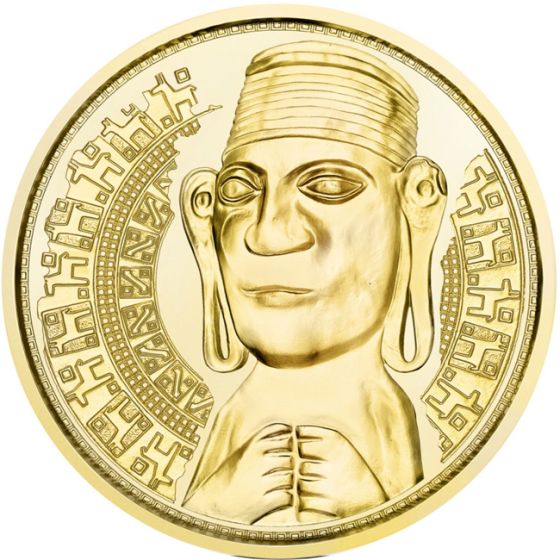
The coin’s reverse shows an oréjon, a golden votive offering of an Inca nobleman,
against an ornamental background.