

 USD ($)
 EUR (€)
 JPY (¥)
 SGD (S$)
SKU
01123001
2023 1/4 oz Austria Gold 2023 1/4 oz Austria Gold Tina Blau PP PP
Tax:
0%
* excl. shipping
Annotation:
The images displayed are iconic photos.
This product is NOT subject to the right of withdrawal.
| SKU | 01123001 |
|---|---|
| Description | 5 – in capsule with certificate, case and ribbon |
| Condition | Polished slab |
| Face Value | EUR 50 |
| Fineness | 986/1000 |
| Country | Austria |
| Weight (g) | 7.890000 |
| Fine Weight (g) | 7.780000 |
| Material | Gold |
| Diameter (mm) | 22 |
| Condition | PR |
| Mintage | 20000 |
| Series | Homeland of Great Daughters |
| Issue Date | 15.02.2023 |
| Delivery date | Immediate |
The first unsung Austrian heroine in this fascinating series, Tina Blau, born in Vienna in 1845, was drawn to painting as a child. In those days, aspiring female painters had to rely on private lessons as there were no official training opportunities for them, but she was fortunate to have a highly supportive father.
Not content to work in a studio, she painted landscapes at a time when outdoor painting was not very popular and was among the first Austrian artists to travel through Austria and other European countries in search of new subjects. Characterised by the rediscovery of Biedermeier realism, her style also showed impressionistic tendencies. She painted her masterpiece Spring in the Prater in the meadows of the Viennese park in 1882. Unprecedented in its brightness, the painting made Tina Blau an artist of European standing.
In 1883, she moved to Munich where she taught at the Women Artists’ Association. Her first major exhibition was held there in 1890; she later exhibited her work at the Chicago World’s Fair in 1893 and her work was presented at many subsequent international exhibitions. In 1897, she helped found the Wiener Frauenakademie, an art school for women in Vienna, where she taught until 1915. A truly modern painter and thinker, Tina Blau was a courageous and independent personality who had a profound effect on the next generations of women artists. She died in the Austrian capital in 1916.
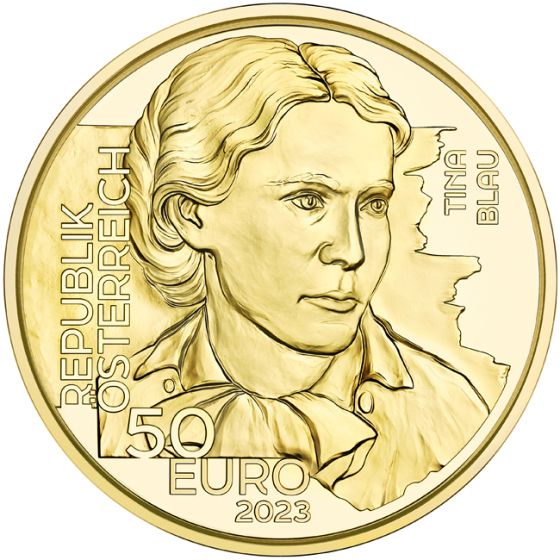
The coin’s obverse features a likeness of Tina Blau taken from a photograph from her youth. A broad brushstroke dominates the background of the coin. Decorated with trees and flowers, the right-hand side of the coin’s reverse focuses on the landscape painting for which Tina Blau became famous. The portraits of two women on the left allude to her time teaching at the Wiener Frauenakademie.